How Targeted Neurofeedback Retrains Your Brain For Peak Emotional Regulation
Neurofeedback shows you your own brain activity in real time and rewards you when it shifts toward a healthier pattern.
The goal is to help your brain get better at staying steady under stress. Some people report real benefits.
But the research is mixed, so it works best as one tool among several.
You know the feeling. Someone says one wrong thing, and you go from fine to furious in about four seconds. Or a small worry turns into a spiral at 3 a.m.
That’s an emotional regulation problem. Your brain’s brakes aren’t catching fast enough.
So a lot of people wonder if there’s a way to train those brakes. That’s where neurofeedback comes in.
In this article:
- What neurofeedback is
- How it’s supposed to work
- What a session looks like
- What the research actually says
- Who might consider it
- What else helps with emotional regulation
- Questions to ask before you start
What Is Neurofeedback?
Think of it as a mirror for your brain activity.
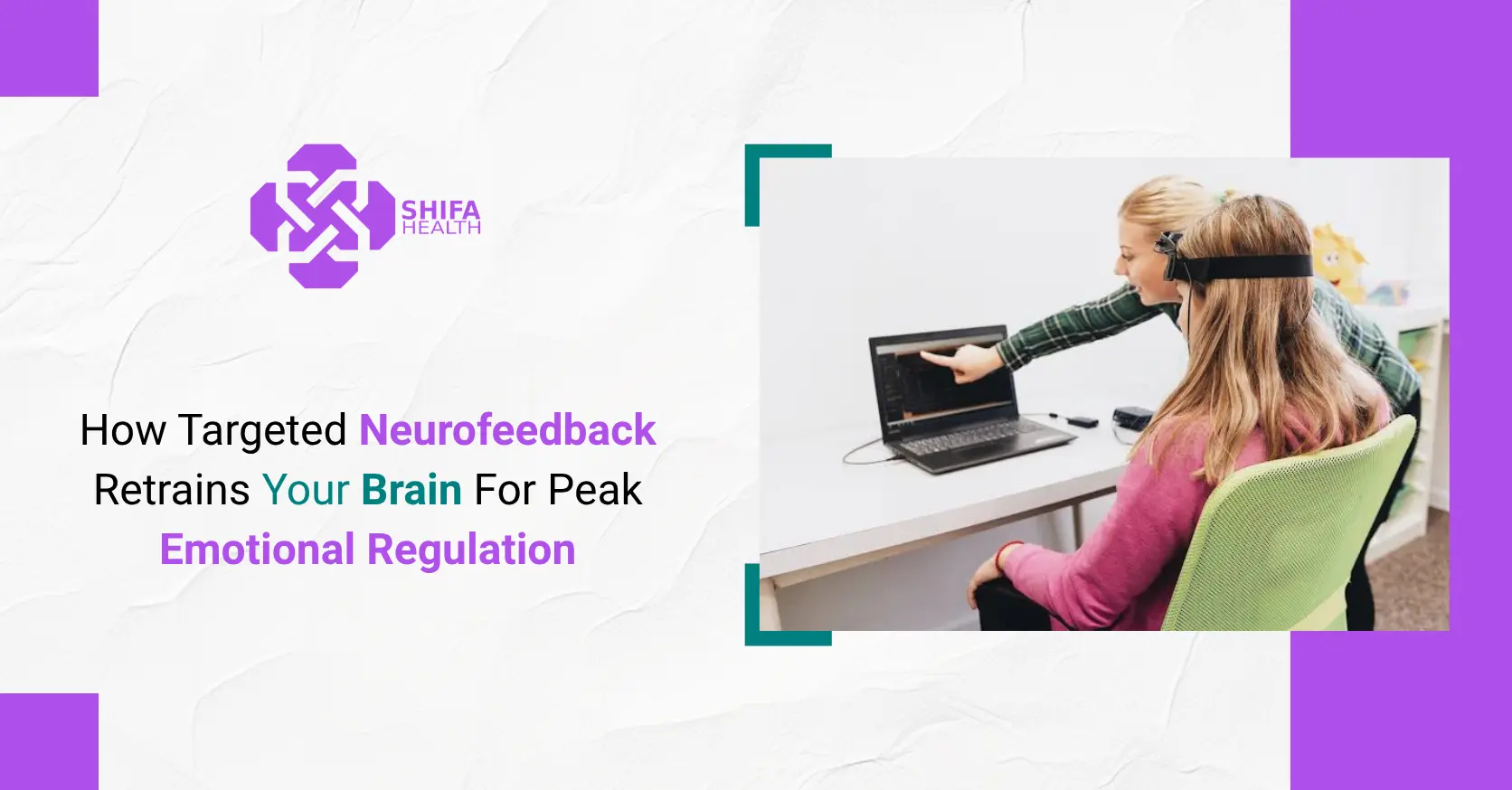
Sensors on your scalp pick up your brain’s electrical signals.
A computer turns those signals into something you can see or hear – like a video that plays more smoothly or a tone that gets clearer.
When your brain activity moves toward a target pattern, you get a reward. When it drifts, the reward fades.
Over many sessions, the idea is that your brain learns what that “steadier” state feels like and finds its way back more easily. It’s a bit like biofeedback for your heart rate or breathing, just aimed at brain waves.
It’s non-invasive. No needles, no electric shocks, no medication.
Why Does Emotional Regulation Matter So Much?
Emotional regulation is how well you manage big feelings. It’s not about hiding them. It’s about not getting swept away.
When it’s working, you can:
- Feel angry without blowing up
- Feel anxious without freezing
- Bounce back from a bad day faster
- Think before you react
- Sleep better after a stressful day
When it’s not, you might notice:
- Quick, intense mood swings
- Snapping at people you love
- Feeling overwhelmed by small things
- Trouble calming down once you’re upset
- Racing thoughts that won’t quit
Under the hood, a lot of this comes down to how well the thinking part of your brain (the prefrontal cortex) talks to your alarm system (the amygdala). When that conversation is shaky, emotions can run the show.
How Is Neurofeedback Supposed to Work?
Your brain makes electrical rhythms, often called brain waves. Different rhythms are linked to different states.
- Slower waves show up more in drowsy or unfocused states
- Faster waves show up more during alertness and, sometimes, tension
- Balance between them is thought to relate to focus and mood
Neurofeedback tries to nudge those patterns toward a more balanced range. The thinking is that the brain learns through repetition, the same way you learn to ride a bike.
That’s the theory. And it’s a reasonable one. But theory and proof are two different things, and we’ll get to that.
What Does a Neurofeedback Session Look Like?
Every provider does things a little differently. In general:
- Assessment first. A provider reviews your symptoms and history. Some also use a brain map (more on that below).
- Sensors go on. Small sensors rest on your scalp and ears. No pain.
- You watch or listen. You sit back and watch a screen or listen to audio.
- The feedback responds. It changes in real time as your brain activity shifts.
- You relax. You aren’t “trying hard.” You’re mostly letting your brain figure it out.
Sessions often run 30 to 60 minutes. Many programs involve 20 or more sessions over several weeks to months. So it’s a time commitment.
What’s a QEEG Brain Map?
A QEEG (quantitative EEG) records your brain’s electrical activity for a few minutes and turns it into color-coded maps. At Shifa Health, it takes about 30 to 45 minutes, and you just sit quietly while a headset records.
Our QEEG brain mapping page explains how it’s used, including for diagnosis and for guiding neurofeedback.
Some clinicians use a QEEG to personalize a neurofeedback plan. Others feel it’s less proven. Reasonable experts disagree here, so it’s worth asking your provider how they use it and why.
What Does the Research Actually Say?
Here’s the part many articles skip.
Neurofeedback is exciting, and the research is mixed. Here’s a quick snapshot:
| What We Know | What We Don’t Know Yet |
| Many people report feeling calmer or more focused | Whether the benefit comes from the brain training itself or from expectations and attention |
| Some studies show improvement, especially for inattention in children with ADHD | Whether results hold up when studies are fully blinded |
| It’s generally considered low-risk | Which protocols work best for which person |
| It doesn’t involve medication | How long benefits last |
Study 1: Children With ADHD
A meta-analysis of five randomized trials, with 263 children, found that neurofeedback improved ADHD symptoms according to parents. But those ratings were probably not blinded. Teacher ratings, which were more likely to be blinded, showed a significant improvement only for inattention. The authors called for better-designed studies. (Frontiers in Human Neuroscience, 2014)
Study 2: Adults With ADHD
A well-designed trial of 118 adults compared real neurofeedback, sham (fake) neurofeedback, and a form of group therapy. Everyone improved on symptoms, anxiety, and low mood. But the groups didn’t differ, so real neurofeedback wasn’t shown to beat the sham or the therapy. The authors also said they found no evidence for the purported brain-wave mechanism. (The Lancet Psychiatry, 2017, summarized here)
So what does that mean for you?
It doesn’t mean neurofeedback is a scam. People did get better. It just means we can’t yet say the brain-wave training is what made the difference. Attention, routine, hope, and support all play a part in any treatment.
Most of this research is on ADHD. For emotional regulation, anxiety, and mood, the evidence is thinner. That’s worth knowing before you spend time and money.
Who Might Consider Neurofeedback?
It’s not a first-line treatment for most people. But it might be worth discussing if:
- You want a non-medication option
- Standard care helped some, but not enough
- You’re comfortable with the unknowns
- You have the time, and can cover the cost
- You’re also doing other proven things, like therapy
It’s probably not the best starting point if you’re in crisis, can’t sleep at all, or need symptom relief fast.
How Safe Is It?
For most people, neurofeedback is considered low-risk. Some people notice:
- Tiredness after a session
- Headache
- Feeling a bit wired or irritable
- Trouble sleeping that night
These usually pass quickly. Tell your provider if they don’t.
A bigger risk is practical. It can cost a lot, take months, and delay care that has stronger evidence if you’re really struggling.
What Else Helps With Emotional Regulation?
These have strong support, and they work well together:
- Skills-basedpsychotherapy teaches you to spot triggers, slow down, and respond differently.
- Tired brains overreact. Fix this first if you can.
- Even a short walk helps burn off stress.
- Mindfulness and breathing. Slow, steady breaths calm the body’s alarm.
- Less alcohol and caffeine. Both can crank up anxiety and mood swings.
- Medication, when it’s right for you. See our page on medication management.
- Treating what’s underneath. Anxiety, depression, ADHD, and PTSD can all make emotions harder to manage.
- Brain stimulation for depression. For treatment-resistant depression, TMS therapy is an option.
Want to start with simple daily tools? Try our post on calming your anxious brain with lifestyle tweaks.
Questions to Ask Before You Try Neurofeedback
Any provider should be happy to answer these:
- What’s your training and certification?
- What will you treat, and what’s the evidence for that condition?
- How many sessions will I need, and what will it cost in total?
- How will we measure whether it’s working?
- What happens if it isn’t?
- Will this work alongside my therapy or medication?
- Do you promise results? (If yes, be careful.)
Be wary of anyone who:
- Guarantees a cure
- Says it works for everything
- Tells you to stop your medication
- Won’t explain how progress is measured
How Does Shifa Health Approach This?
At Shifa Health, we start with you, not a machine. A psychiatric evaluation helps us understand what’s going on, and we can talk through which options make sense, including brain mapping, therapy, medication, and other treatments.
Our Precision Wellness approach also looks at things like genetics and lifestyle, so your plan fits your brain and your life.
We’re honest about what has strong evidence and what’s still being studied. That’s how we’d want to be treated, too.
FAQs
Does neurofeedback really work?
Some people feel better, but the research is mixed. In some well-designed studies, real neurofeedback didn’t beat sham treatment, so we can’t say yet that the brain-wave training itself is the reason.
It’s best seen as one possible tool, not a cure.
How long does neurofeedback take to work?
Programs often run 20 or more sessions over several weeks to months. Some people notice changes sooner, and others don’t notice much. Your provider should set clear checkpoints.
What’s the difference between neurofeedback and TMS?
Neurofeedback teaches your brain to shift its own activity using feedback! TMS uses magnetic pulses to stimulate specific brain areas, and it’s used for conditions like treatment-resistant depression. They’re different tools.
Is a QEEG brain map the same as neurofeedback?
No. A QEEG is a recording and analysis of your brain’s electrical activity. Neurofeedback is training. Some providers use a QEEG to plan neurofeedback.
Will insurance cover it?
Coverage varies a lot. At Shifa, insurance generally covers the physician assessment visit, not the QEEG itself. Ask your provider and your insurance company before starting.
When Should I Get Help for Emotional Regulation?
Reach out if:
- Your emotions feel out of control most days
- Anger or anxiety is damaging your relationships or work
- You’re using alcohol or drugs to cope
- You feel hopeless or numb
- You’ve had thoughts of harming yourself or someone else
If you’re in crisis or thinking about suicide, call or text 988 any time. If someone is in immediate danger, call 911.
Take the Next Step
You don’t have to white-knuckle your emotions alone. If you’re curious about brain mapping, therapy, or any other option, let’s talk it through.
- Book a free consultation
- Call our Everett office at (425) 742-4600
- Call our Mount Vernon office at (360) 336-6868
- Learn about QEEG brain mapping
- Explore all our services
This article is for education only and isn’t medical advice. Treatment decisions should be made with a licensed clinician who knows your history.