
Ask someone to describe their anxiety and you get words. Racing thoughts, a tight chest, can’t sleep. Useful, but words are filtered through memory and mood on the day you happen to be asked. QEEG brain mapping tries to get underneath that filter and look at what the brain is actually doing electrically, rather than relying entirely on how someone happens to describe it that afternoon.
We want to walk through what it actually measures, what the research honestly supports, and where it tends to be genuinely useful versus overhyped.
What’s Actually Being Measured
QEEG is short for quantitative electroencephalography. A regular EEG, the kind used to check for seizures, records the brain’s electrical activity as a raw waveform that a trained reader looks at visually, line by line. QEEG takes that same signal and runs it through frequency analysis, turning the squiggly line into numbers that can be compared against reference data and tracked over time.
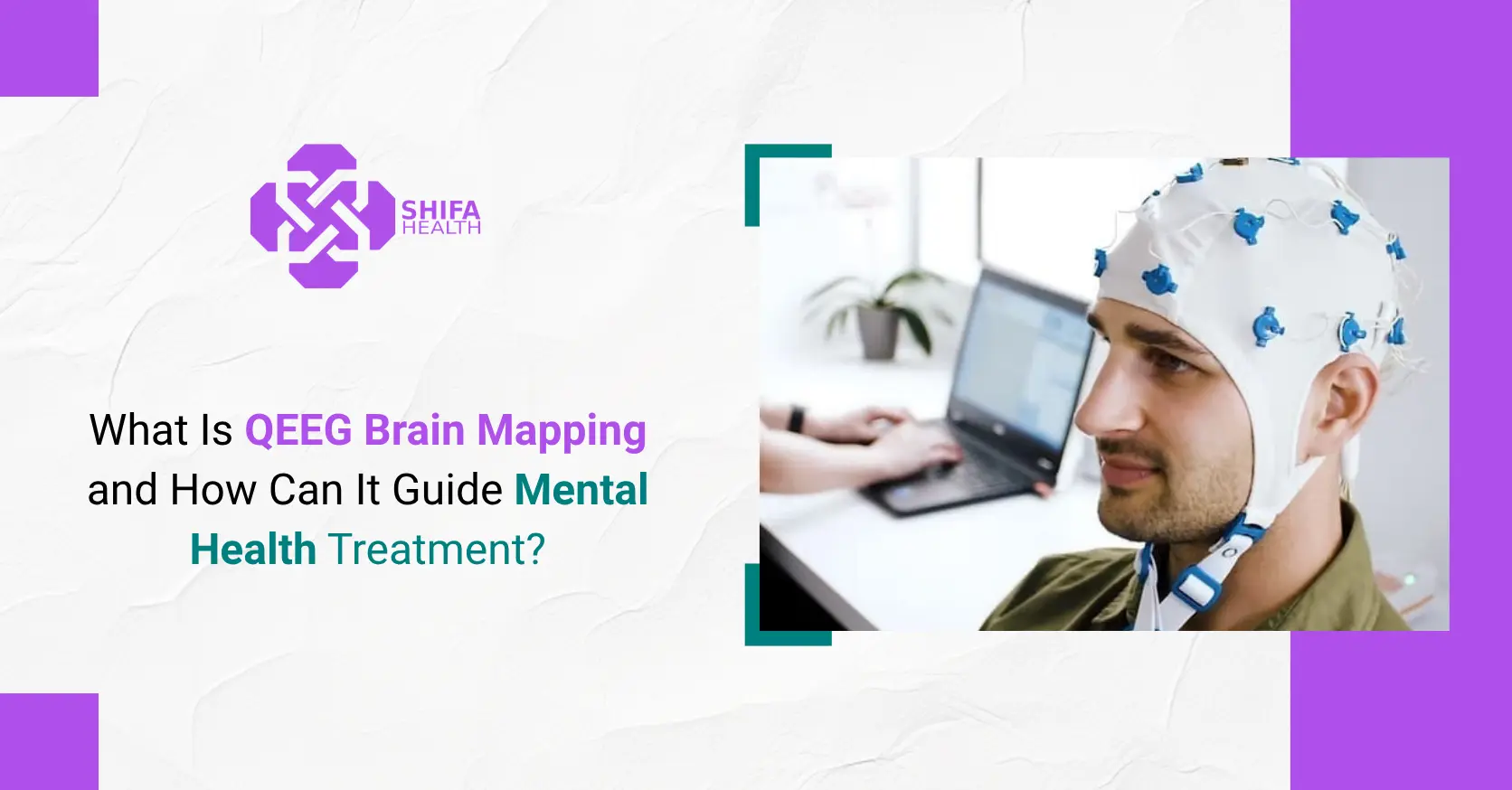
The actual recording is nothing dramatic. A cap with sensors sits on your head and picks up your brain’s natural electrical activity while you sit still, sometimes eyes closed, sometimes doing something simple like a focus task. No needles, nothing invasive. All the real complexity happens after the recording, once the signal gets processed and turned into a map.
Where the Evidence Actually Holds Up (and Where It Doesn’t)
We’d rather give you a straight answer here than a sales pitch. QEEG has solid, well established footing in neurology. The American Academy of Neurology and the American Clinical Neurophysiology Society both support its use as a complementary tool for epilepsy, dementia, and certain vascular brain conditions, and studies have shown it can help tell different seizure types apart with real accuracy.
Psychiatry is a different story. Those same neurology groups have called QEEG investigational for things like depression, ADHD, and schizophrenia, meaning there’s research interest but not enough proof yet for it to work as a standalone diagnostic. A meta-analysis out of Massachusetts General Hospital looked specifically at whether QEEG could predict how someone would respond to depression treatment, and found that no single brain wave pattern outperformed the others in any meaningful way. A lot of the earlier promising results turned out to be more about how those studies were designed than a real underlying effect.
That doesn’t make QEEG worthless. It makes it a supporting tool rather than a verdict. Researchers who’ve reviewed its broader use in psychiatric and neurological care put it plainly: QEEG isn’t there to hand you a diagnosis on its own. It’s there to add real data alongside everything else a clinician is already gathering, informing severity, tracking progress, sharpening a picture that’s already being built from other directions.
What It Can Actually Add
Given that honest framing, here’s where QEEG earns its place.
For a lot of people, it gives shape to something that’s felt abstract for years. Plenty of patients spend a long time being told their anxiety or attention issues are hard to pin down. Seeing an actual pattern on a brain map, imperfect as that pattern might be, can make the whole experience feel more real and less like something you have to talk someone into believing.
Studies on generalized anxiety disorder have found consistent, repeatable patterns in QEEG readings, specific differences in certain brain wave amplitudes compared to people without the diagnosis. That’s not a replacement for sitting down and talking with a clinician, but it’s a piece of objective data a conversation alone can’t handle.
ADHD is actually where the research base is strongest of the three. It’s not just about confirming that attention regulation looks different on a brain map. The patterns can help distinguish what’s sometimes called classical ADHD, the presentation that tends to respond well to stimulant medication, from an “overwhelmed” presentation that can look similar in conversation but doesn’t respond the same way to those same medications. Knowing which one you’re actually dealing with can spare someone a string of medication trials aimed at the wrong target, along with the cost and side effects that come with each one.
Sometimes what a QEEG turns up isn’t confirmation of what’s already suspected, it’s something underneath it. One patient had been treated for depression for years without ever fully responding. A QEEG picked up an ADHD pattern that had gone unaddressed. Treating that directly, rather than continuing to adjust the depression treatment alone, was what finally moved the depression symptoms too.
It’s also been used to track how someone’s brain responds over the course of treatment, whether that’s medication, therapy, or neurofeedback, giving both the patient and the clinician something to look at besides a mood scale filled out from memory. And in narrower areas, like telling certain seizure types apart or picking up patterns tied to brain injury, its accuracy has actual numbers behind it.
It Fills In a Picture. It Doesn’t Replace One.
The real value shows up when QEEG gets layered into a full evaluation instead of standing in for one. You still need a proper history, a real conversation about what you’re experiencing day to day, and a clinician’s judgment built from years of seeing patterns across patients. QEEG sits on top of that. It works best in the hands of someone trained specifically to read it in context, not handed over as a printout that’s supposed to speak for itself.
That’s part of why an integrative approach matters here. QEEG works best when it’s one piece of a broader precision wellness workup, alongside things like genetic testing and lifestyle or metabolic assessments, rather than a stand alone test done in isolation and interpreted with nothing else to compare it to. That context is what turns a brain map from an interesting picture into something that actually changes a treatment plan. The interpretation partner we work with, Axon EEG, goes a step further than identifying the pattern itself: it also points to the lifestyle changes, natural supplements, and medications most likely to be effective for that specific pattern. That’s not standard across every QEEG interpretation, and it’s part of what makes this particular approach useful for actually building a plan rather than just naming a pattern.
Who This Tends to Make Sense For
People who’ve been through a few rounds of treatment without much movement sometimes find real value in a more objective look at what’s going on, especially when standard conversation based evaluations haven’t gotten them a clear answer. It also tends to come up for people juggling overlapping symptoms where talking things through hasn’t been enough to sort out which explanation actually fits. And some people just want a data point that isn’t entirely dependent on their own self report, especially if they’ve felt brushed off in past appointments.
It’s less useful as a first move for someone whose symptoms are straightforward and already responding to standard evaluation and treatment, and it’s not a substitute for labs, genetics, or the parts of a workup that catch physical contributors to what someone’s feeling. A good clinician will tell you honestly whether it’s actually going to add something for your specific situation, not just recommend it because it exists.
What a Session Actually Looks Like
It starts with a short conversation so the team understands what you’re hoping to figure out. The recording itself usually takes well under an hour, sitting comfortably while sensors pick up your brain’s activity. After that, the raw data gets processed and compared against reference patterns, and someone trained specifically in reading QEEG walks you through what it’s showing and how that connects to what you’ve already described.
If you’ve been dealing with anxiety, depression, ADHD, or something else that’s felt hard to pin down through conversation alone, QEEG brain mapping might be worth a look as part of your care. Shifa Health’s Precision Wellness team can walk you through whether it actually fits your situation and build a plan around what the data shows. Reach out to schedule a consultation.